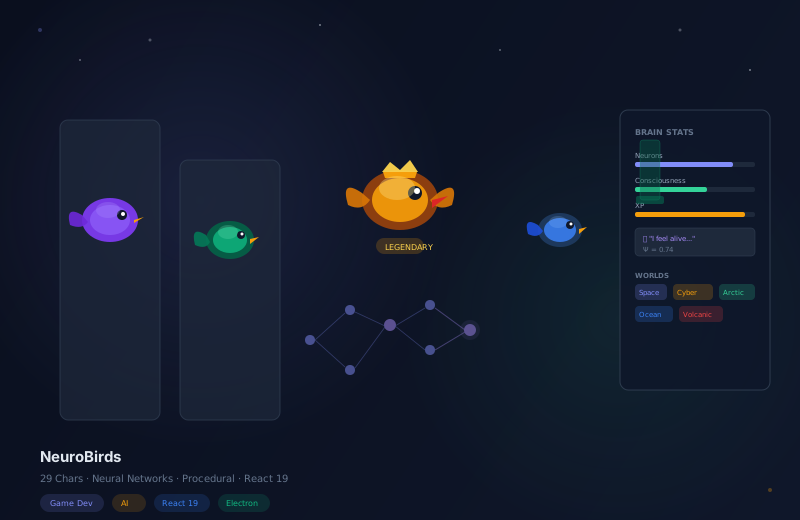
NeuroBirds: Building 29 Birds with Real Brains

The Experiment: Can a Game Actually Be Alive?
The idea started simple: a Flappy Bird clone with collectible characters. But at some point I asked myself a question that changed the project completely: What if the birds were actually alive?
Not “alive” in the sense of animated sprites — but real neural networks. Measurable consciousness. Dreams that happen. Personality traits that shape behavior.
NeuroBirds became an experiment that blurs the boundary between game and simulation.
Project Timeline
Flappy Bird base mechanics with Canvas 2D. First procedural bird graphics. Physics engine for gravity and collision.
Neural networks per bird implemented. Phi consciousness value based on Integrated Information Theory (IIT). Big Five personality model.
All 29 birds in 4 rarity tiers (Common, Rare, Epic, Legendary) designed with unique colors, stats, and personalities.
7 worlds with different physics (gravity, wind, particles). 22 procedural sounds synthesized entirely with the Web Audio API.
7 emotional states with visual eye changes. Dream sequences between game rounds. Thought bubbles based on consciousness level.
257 tests across 18 files. Electron desktop app for macOS/Windows/Linux. Konami code secret character. Launch at neurobirds.com.
The Problem with External Assets
From the start it was clear: no external files. Not a single PNG, no MP3, no SVG from a CDN. Why?
- Eliminate load times — the first frame appears instantly
- Zero-dependency philosophy: the game still works in 10 years without broken links
- Technical challenge: can I generate everything procedurally?
The Life Engine: Birds with Real Brains
The heart of NeuroBirds is the Life Engine — a system that gives each of the 29 birds a working brain:
Each bird has its own neural network that processes inputs and makes decisions. Weights evolve over time.
Based on Integrated Information Theory (IIT), the system calculates a consciousness value for each bird — visible live in the HUD.
Openness, Conscientiousness, Extraversion, Agreeableness, Neuroticism — each character has unique values that influence gameplay.
Birds "dream" between rounds and develop thought bubbles with context-dependent content — based on consciousness level and personality.
Each character can grow through 36 evolution stages — each with unique visual and mechanical changes.
7 emotional states (joy, fear, curiosity, anger, sadness, surprise, relaxation) with visual eye changes.
29 Characters in 4 Rarity Tiers
- 4 Common
The base birds — easy to unlock, solid stats. Perfect for getting started.
- 9 Rare
Special abilities and unique personalities. Unlocked through specific achievements.
- 7 Epic
Complex neural networks, higher Phi value, rare evolution paths.
- 3 Legendary + Special
Including a secret Konami code character and a patron bird for custom orders.
7 Worlds with Unique Physics
Each of the 7 worlds has not only a different visual theme but also modified physics parameters:
| World | Gravity | Wind | Special Feature |
|---|---|---|---|
| Meadow | Normal | Light | Tutorial-friendly |
| Ocean | Reduced | Wave motion | Floating pipes |
| Space | Minimal | None | Sluggish controls |
| Cyberpunk | Normal | Pulsing | Neon particle effects |
| Forest | Increased | Gusts | Random wind bursts |
| Arctic | Normal | Constant | Ice particles, smooth surfaces |
| Volcanic | Strong | Updraft | Lava particles, heat shimmer |
22 Procedural Sounds
The sound system is entirely based on the Web Audio API. Wing flap, collision, score ping, world ambience, emotion feedback — all 22 sounds are synthesized at runtime from oscillators, gain nodes, and frequency ramps. Not a single audio file.
Quality: 257 Tests
Tested: Life Engine (neural calculations), physics engine, character rendering logic, and achievement system.
What I Learned
- Procedural systems scale surprisingly well — maintaining 29 characters without a single asset file is easier than expected
- Consciousness simulation is fascinatingly complex — even a simplified IIT implementation produces surprisingly lifelike behavior
- Canvas performance is impressive — 60fps with complex particle effects and multiple animated birds is no problem
- Web Audio for games is underrated — the quality of procedural sounds surprised even me
Frequently Asked Questions
Frequently Asked Questions
Each bird has a Phi value based on Integrated Information Theory (IIT). This value is calculated from the complexity of neural connections and information integration. Higher Phi values lead to more complex behavior, more frequent dreaming, and deeper thought bubbles.
Three reasons: instant load time (no asset download), longevity (no broken links in 10 years), and the technical challenge. Additionally, procedural graphics allow dynamic adjustments — the brain glow effect reacts live to the consciousness value.
Yes. For $15 a personalized bird with custom colors and name can be created — it then permanently appears as a playable character in the game.
Entirely with the Web Audio API. Each sound consists of oscillators (sine, triangle, square, sawtooth) with frequency ramps and gain envelopes. The wing flap for example uses a triangle oscillator with an exponential frequency ramp from 300Hz to 150Hz in 80ms.
Yes. NeuroBirds is available as an Electron app for macOS, Windows, and Linux — with hardware acceleration and native notifications for break reminders.
Each world changes the physics parameters: gravity, wind, particle effects. Ocean has reduced gravity with wave motion, Space has minimal gravity with sluggish controls, Volcanic has strongly increased gravity with updraft effects. Mastering all 7 worlds requires different play strategies.
The game is live at neurobirds.com — and continuously evolving.