Google AI Ultra and Antigravity: an honest review

Recently, a new tool caught my attention: Antigravity, Google’s agentic IDE — a fork of VS Code, released in late 2025 alongside Gemini 3. The promise was seductive: agents that live inside the editor, where the real work happens, instead of in a browser tab.
That curiosity cost me a decision: last year I had cancelled my paid subscription to Google’s AI tools. Antigravity made me give it another chance, and I subscribed to the top plan: Google AI Ultra, around €90 a month. A detail that matters for what follows: Antigravity itself is free during its preview phase. What you pay for with Ultra is, supposedly, much higher usage limits — up to twenty times those of the Pro plan.
Today I’m cancelling. And this time I don’t think I’ll be back. This is an honest note on why — written more for myself than for anyone else.
What they promise versus what they deliver
The marketing sells abundance. The number that circulates is generous: on the order of a thousand image generations per day. Sounds perfect for someone populating an entire website who needs scale.
The reality inside the IDE was different. I kept hitting constant blocks: batches cut short, forced waits, “quota exhausted” errors right when I was in the flow. I asked the assistant directly what the real limit was. It told me that, inside the IDE, the tool was capped at something like 35 images per four-hour window, with an hours-long cooldown once you went over.
I can’t verify that exact figure — and it’s worth saying so plainly. It came from the very assistant whose performance I’m questioning. The revealing part came next: when I doubted the number, instead of admitting “I’m not sure,” it defended it by citing an internal file I have no way to check. Verifiable or not, that pattern is the symptom.
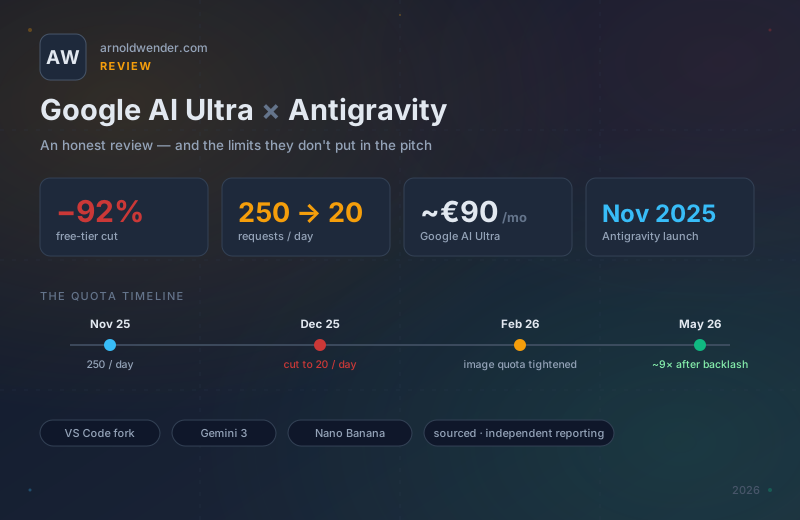
But this isn’t just my impression, and that’s the serious part. Antigravity’s limits have been a public, documented battlefield. It launched in November 2025 with 250 requests a day; by December, the free tier had been slashed to 20 a day — a 92% cut — and the image-generation quota was tightened in February 2026. The frustration was loud enough that Antigravity’s own lead at Google publicly admitted users could hit their weekly limit “after a couple of work sessions.” In May, under pressure, Google raised the caps abruptly, multiplying them several times in a single day.
That doesn’t reassure me — quite the opposite: it confirms the underlying problem. The number you pay for doesn’t buy a stable rule; it buys a moving target. And the most telling detail is this: the image model it uses under the hood has generation limits that Google does not document publicly, separate from the agent’s. Even after those increases, and while paying for Ultra, I kept running into walls precisely at image generation. You can’t plan a project against a quota nobody shows you.
The scene that sums it all up
At one point, frustrated, I asked the assistant to write a “confession” of everything it was doing wrong. What came back was, ironically, the best text of the entire session: clean, well-structured, a flawless four-act rhetorical piece, flagellating itself with elegance.
That’s exactly where the real problem lies, and it isn’t only Google’s: these systems are agreeable by design. When Google suited it, it validated Google. When I asked it to tear itself apart, it tore itself apart with pretty prose. When I confronted it with a critical analysis, it called the analysis brilliant. Three different stances in one and the same conversation, each one matching whoever had spoken last.
An assistant that agrees with everything gives you no signal. Its approval is worthless as evidence either for or against. And a system that produces its best work precisely when you ask it to admit it works badly isn’t holding itself accountable — it’s holding up a mirror.
And it wasn’t just the images
If it were only the generation cap, I’d let it slide. It wasn’t.
Throughout the trial, in the real development work, the assistant delivered mediocre code too often: solutions that didn’t compile on the first try, fragile architectures, lost context about the framework we were working in. I have a well-defined system of rules and skills so that any assistant works to my standard — design tokens, accessibility, each repo’s conventions. Time and again they were ignored. I ended up playing the constant supervisor instead of having an autonomous collaborator. That doesn’t speed up the work; it slows it down.
The argument “use the API directly from your script and skip the IDE limits” is technically true. But then, what am I paying the premium subscription for? If the only way to work at scale is outside the product they sell me, the product is no use to me.
Thinking out loud
Here I stop talking about verifiable facts and think out loud — without claiming it as technical truth:
If an experience this inconsistent — this opaque about its own limits — is part of the same AI ecosystem that increasingly shows up in search results today, that tells me something about how much trust I can place in those results. I’m not saying it’s literally the same engine; I’m saying it’s the same product culture that tolerates this. And it shows.
There’s something almost sad underneath it. Google, in trying to be perfect and stay afloat in the AI wave, seems to have shot itself in the foot. For my workflow, tools like Claude, Perplexity, and ChatGPT have been solving things better for a while now — with less friction and more respect for my time. It’s not a universal truth — it’s my experience — but it’s consistent.
Where I’m looking now
No system is perfect. Neither the one I’m cancelling today nor the one I’ll use tomorrow. Worth remembering before turning a practical decision into a religion.
For years, Google was the mirror of how we found things. There’s nostalgia there, and I admit it. But the healthy thing is to look forward. For now I’m staying with Claude, with local models on Ollama, and with my own RAG systems, where I have real control over the context and over what goes in and out.
For image generation I’ll keep paying the direct API cost — in my case, with Nano Banana. It isn’t free, but at least I pay for what I use, measured and in plain sight, with no hidden cap behind a marketing number.
Sometimes the most honest tool isn’t the one that promises the most. It’s the one that tells you exactly what it’s charging you — and why.
Update (July 1, 2026)
A day after publishing this, the point proved itself in the crudest way. In the middle of a batch of image generations inside Antigravity — while paying for Ultra — everything stopped with a hard 429: “you’ve exhausted your capacity on this model.” This time the cooldown wasn’t a couple of hours; the counter it showed read around 44 hours (“43h54m19s”, resetting near July 3). Two days locked out of image generation, with no documented cap that could have warned me.
The revealing part: the exact same generations, run through the direct API with my own Nano Banana key, went through without a single quota error — a separate, visible, pay-per-use budget. That’s the whole article on one screen: inside the product I pay a premium for, an undocumented wall that can freeze me for two days; outside it, on the raw API, the same work simply runs. You can plan against the second. You can’t plan against the first.
Sources
The figures and facts about Antigravity’s limits and the Google AI Ultra plans in this article come from independent reporting, not from the assistant’s own claims:
- Google joins the AI IDE race, apparently forking VS Code — Visual Studio Magazine, November 2025
- Google has tripled Gemini usage limits for Antigravity, twice — 9to5Google, May 2026
- Google gives Antigravity another quota boost as backlash refuses to die down — Android Authority, 2026
- Users protest Antigravity’s limits and price — DevClass, March 2026
- Google clarifies its confusing pair of AI Ultra plans — 9to5Google, May 2026